1816 – Ha’penny Bridge, Dublin

1816 – Ha’penny Bridge, Dublin

hapenny_new2_lge

hapenny_new_lgehapenny_piers_lgehapenny_section_lge

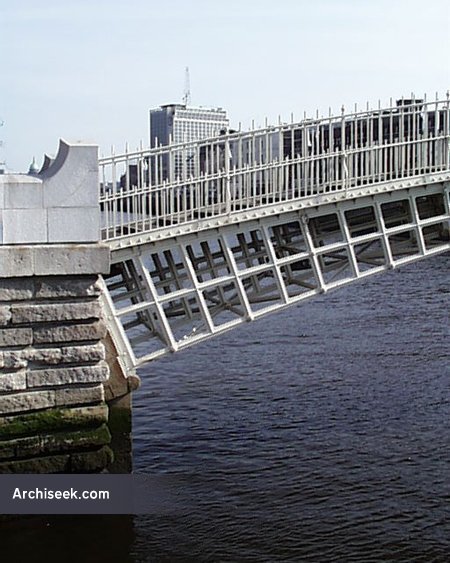
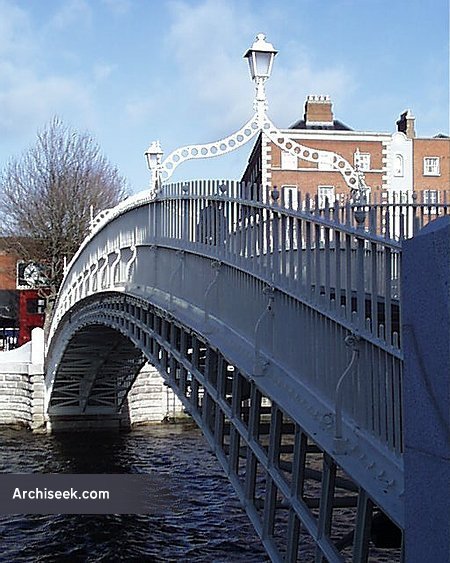
Accepted as the symbol of Dublin, the Ha’penny Bridge (offically Wellington Bridge after the ‘Iron Duke’) was opened in 1816. Cast at Coalbrookdale in Shropshire in England, the bridge acquired its unofficial moniker from the toll paid to cross the river – one old half penny. The bridge was the only pedestrian bridge on the Liffey until the Millennium bridge further up was opened in 2000.

The bridge has three lamps supported by curved ironwork over the walkway. In a bad state of repair, the bridge was closed in 2001 for major repair. It was reopened, with its original paint colour restored and changed made at the ends to allow standing room for pedestrians before crossing the road. The original line of the decking was restored.

Related Articles:

  • Architect: Cyril O'Neill This pedestrian bridge, which links Custom House Quay with City Quay, is named after the Dublin writer Sean O'Casey. The bridge is directly opposite Stack A, the 19th century warehouse i ...

  • Architect: Santiago Calatrava Named after the Dublin author James Joyce whose story "The Dead" is set in a house facing the bridge, this was one of two Santiago Calatrava projects planned for Dublin - the othe ...

  • Opened in 1859, Rory O'More Bridge is named after one of the ringleaders of a plot to capture Dublin in October 1641. Previously the bridge was known as Queen Victoria Bridge. Prior to the bridge been built, an earlier ...

  • Architect: Santiago Calatrava Dublin's Samuel Beckett Bridge, designed by internationally renowned architect Santiago Calatrava cost €60 million and took ten years to complete. The 120-metre long, 48-metre high br ...

  • Originally designed and built by James Gandon, O'Connell Bridge was built in 1794-98 and named aftyer the then Viceroy - Lord Carlisle. The original bridge had a hump and was much narrower and Gandon had designed obeli ...