
1953 – Donnybrook Bus Garage, Donnybrook, Dublin
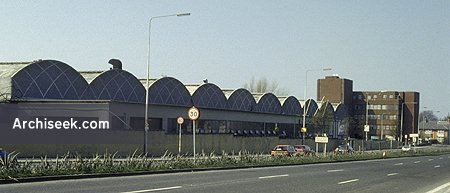
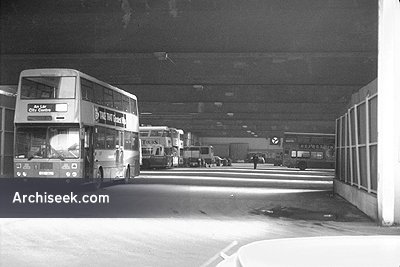


Donnybrook Bus Garage was completed in 1952. This was a much more radical building than the Inchicore Chassis Works and was designed in association with the Danish engineer Ove Arup (1895-1988) whom Michael Scott persuaded to set up offices in Dublin (the first overseas Arup office).
Donnybrook Garage was carried out by some of Scott’s staff in association with another architect Jim Brennan (1912-1967), who in some journals is credited with the building although Scott’s firm is usually listed. Brennan had previously worked for Scott in the late 1930s on Portlaoise Hospital and Scott’s team on this project included Patrick Scott and Kevin Roche. Originally it was the first of a series of eight proposed garages for one hundred buses to be built to the same design around the country. It was the first building in the world to have a concrete shell roof lit by natural light from one end to the other. Each shell was poured in situ with large wooden moulds that were dismantled and moved on to form the next one. This form was suggested by Arup as a suitable approach to the design. The other seven garages were never executed and the concrete moulds were destroyed after the completion of Donnybrook due to Government politics and the advice of a senior civil servant Dan O’Donovan. O’Donovan was a man of very strong personal convictions on building and was later to be appointed to oversee the building of Busáras, to the despair of Scott.
New Dublin Garage Features Shell Roof
Shell concrete construction, which is new to this country is being employed for C.I.E.’s new garage at Donnybrook. This interesting structural method, of German origin, has some affinity with the principal of the egg-shell. Although so thin and seemingly fragile, the common egg-shell has remarkable strength in relation to its weight due to the stresses being so evenly divided over the whole surface.
The roof of the Donnybrook Garage consists of a series of ten segmental shells. Each segment consists of reinforced concrete less than three inches thick. Supports only at the sides and ends, on two rows of columns, the new type of roof has all the strength of conventional type roofs, yet allows an unobstructed covered area 110 feet wide and 400feet long. A veritable forest of timber is being used to support the concrete roofing until it is set, but the timber can be taken down and re-used. This will lead to speed and economy in the erection of a number of provincial C.I.E. garages in the same style. One garage may have, say, only four segments of roof, another may have six, eight, or more; the unit method gives and inexpensive flexibility. Likewise, the materials for this type of shell construction are comparatively easy to obtain and maintenance costs are considerably reduced.
The new Donnybrook garage will double the existing parking and service facilities there and provide for parking 100 double-decked buses. The accommodation is urgently needed for the growing fleet of Dublin’s CIE buses, and it is hoped to use the garage even before the service buildings are ready.
In addition to the covered space, an outdoor parking area will be provided between the new garage and Stillorgan Road.
Included in the Donnybrook project there are eight inspection pits. The fitter’s work benches stand on the pit floor level, as in the existing Donnybrook garage, to avoid climbing up and down steps. Pressurized air, grease, and oil lines are provided for, with sump draining pans connected to a central filter plant. The washing bay, stores, boiler-house and offices likewise will be fitted with the most up-to-date mechanical services.
These ancillary service buildings are to be roofed with flat concrete slabs, and the external walls will be extensively glazed to obtain as much natural lighting as possible.
The main garage will be lighted principally through long strips of roof lights between the shell segments. To have roof lights, for natural lighting, running the full width of the building, represents an advance on other shell concrete buildings which have been erected abroad in recent years.
In front of the main supporting columns of the garage, will be screen walls perforated by small regularly spaced vertical windows for local lighting. A projecting horizontal nib separate this wall from the stiffening spandrils of the shells above.
Some special difficulties were found and overcome in connection with the foundations for the new garage. The site lies partly over one formerly occupied by a Dublin tramways depot from which horse-trams once operated, and partly over an old quarry which had been filled in from the depot (and later from the garage) with all kinds of rubbish. As this filling of rubbish formed very unstable ground, piling had to be undertaken and reinforced concrete piles were cast in situ.
Bedrock was found at depths varying from 20 feet to about 90 feet. At one place, it was found at first that the pile driver was bouncing on some heaps of old motor tyres which had been buried several years ago in the quarry, at a depth of 30 to 45 feet. This problem was solved by consolidating the ground with sand-cement grout forced into it under pressure.
The rection of the first five bays of the garage is in progress and is well advanced. Piling for the other half of the garage is being completed.
Cuisle Na Tire, March 1949
Externally the building’s elevations are dictated by the roof form which is visible along the sides. Smaller flat roofed buildings were built next to it but do not intrude on the distinctive shape of the building. The faith that Scott showed in the ability of Arup, in allowing him to dictate the external appearance of the building through its engineering was to be repeated at Busáras. Decorative ribs are visible along the side elevations. Originally it was coloured externally in a grey and yellow paint scheme designed by Patrick Scott, which has since been painted over. Internally the garage is an imposing well-lit internal space uninterrupted by columns or internal walls.
Share!
Published February 1, 2010 | Last Updated January 23, 2026


